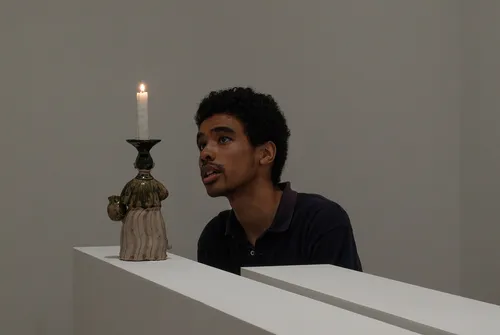
Sokyo Gallery (Kyoto) is pleased to present Temptation by Space, American artist Tyler Coburn’s first show with the gallery. The exhibition comprises two projects—Candlestick Man (2023– ) and The Petrified (2022– )—that share an interest in speculation while respectively considering early Japanese-European cultural exchange and the politics of western heritage museums. Reflecting Coburn’s ongoing engagement with creative practitioners in Japan, Temptation by Space includes contributions by Taro Mizushima, Wataru Naganuma, and Jiro Sasaki.
The front gallery hosts a new installation of Candlestick Man, which Coburn developed during the Tokyo Arts and Space International Creator Residency Program in 2023. Along one wall are several modern facsimiles of Oribe ware candlesticks, which depict the first Europeans to arrive in Japan in the sixteenth and seventeenth centuries. Largely fashioned by Jiro Sasaki, each has a Japanese candle (warosoku) that Coburn produced on a residency at Sokyo Gallery this March, drawing on techniques he learned from Kyoto workshop Nakamura Rosoku. The candles comprise haze wax—the traditional material for warosoku—as well as oil infused with lichens that Coburn collected from the site on Tanegashima where the Portuguese landed in 1543.
On the opposing wall is a subtle sculpture by Coburn in the gofun of Kyoto manufacturer Ueba Esou. Misusing gofun as putty, Coburn copied the lichen dots from an early-seventeenth-century folding screen by Kanō Sanraku showing the Portuguese arriving in Nagasaki. During storytelling performances on the opening and closing weekends of the exhibition, Coburn and Wataru Naganuma will light some candles and use this wall as a prop, opening various sensory portals to the past.
En route to the rear gallery are certain “backstage” elements of Candlestick Man. First, on a tatami display, sit two sculptures that Coburn and Sasaki made together in 2025: one of Coburn at Sasaki’s age at the time, and the other of Sasaki at Coburn’s age at the time (respectively, seventy and forty-one). Operating like nesting dolls, the men hold miniature versions of the candlesticks in the front gallery. Second, in a display nook, are shipping boxes and shaft-like sculptures of the same materials as the candles. Their shape mimics that of the copper ingots exported by Japan to China and The Netherlands in the seventeenth century. Ingots are intermediate forms designed to be melted and recast; in Temptation by Space, the ingots on view are a reserve supply of candle-making material.
The rear gallery hosts The Petrified, an interdisciplinary project that imagines a parallel world in which, between 2009 and 2019, several people petrified in Western heritage museums.
On a bench is a booklet of stories about these people that Coburn first published in e-flux journal in 2022. Written in a style of literary reportage, the texts draw on recent events and debates pertaining to cultural restitution and repatriation, the private financing of museums, and the politics of collecting and conserving. Visitors are invited to sit and read.
The walls of the rear gallery display new additions to Coburn’s ongoing series of works on paper, expressing how the surfaces of the petrified bodies—as told in his stories—are speckled with the colors of the galleries they occupy. Coburn shot videos of those galleries then used 3D software to turn them into point clouds, which inspired his speckled technique. While in residence at Sokyo Gallery, he began using suihi-enogu to make this work, allowing the sediment to spread and settle in chance formations on the paper.
At a key moment in Coburn’s stories, he describes a hollow, lifelike sculpture in The Metropolitan Museum of Art, New York fashioned using a dry-lacquer technique (kanshitsu). By way of pointing to this reference, Coburn has selected certain kanshitsu sculptures by Taro Mizushima for display throughout the rear gallery. Often roughly made and vaguely figurative, they stage a cryptic conversation with Coburn’s abstract yet bodily watercolors.
The title of the exhibition, Temptation by Space, excerpts Roger Caillois’s 1935 essay “Mimicry and Legendary Psychasthenia.” In the text, the writer makes an analogy between insects that visually mimic their environments and the human desire to deindividualize and merge with what surrounds. This “temptation,” which Coburn references in his stories for The Petrified, may explain why his characters turn to stone in museums. It could also reflect the complexities of exchange in Candlestick Man, as various cultures negotiate their relative bounds and the possibilities that lie between them.
